
A.R.I.A. — Affective Reasoning & Intelligent Adaptation
Most Wearables
Measure Stress.
None of Them Know You.
560 million devices ship the same one-size-fits-all model. We built the personalization layer that makes it accurate — for each individual. A.R.I.A. is the missing API between raw wearable data and real human-state intelligence.
89.4%
Lab accuracy with 5-min calibration
+10pp
Improvement over generic wearable models
84
Subjects tested in real-world conditions
437
Automated tests, ML leakage audited
Samsung
Consumer hardware validated
Lab-validated under controlled conditions. Paper submitting to ACM IMWUT, May 2026. Field validation starting June 2026. Full methodology and data
The Discovery:
Labels, Not Models.
Every competitor is building better algorithms. Our data shows that's the wrong problem. In real-world conditions, all architectures converge. The bottleneck is calibration — how you collect and label the data.
Finding 1
Architecture Converges
In real-world conditions (N=84), all model architectures produce the same accuracy (~56%). Random Forest, XGBoost, deep learning — none outperform the others. Which AI model you use doesn't matter.
Finding 2
Calibration Changes Everything
5 minutes of guided calibration adds +10 percentage points in controlled conditions. That's the gap between a generic stress score and one that actually knows you. Personalization is the product.
Finding 3
First to Measure It
No prior paper compares calibration cost across model families under identical protocols. Our 21-page paper (ACM IMWUT, submitting May 2026) is the first systematic measurement. This reframes the field.
Population-level models (Apple, Garmin)
“Stress: 87%”
Black-box algorithm
Same model for everyone
No personalized calibration
No per-user explainability
A.R.I.A. — Calibrated to you
“Elevated arousal — calibrated to your baseline. Consistent pattern during evaluative contexts.”
Explainable — shows why, not just what
Personalized to each individual
Private — data never leaves the device
Transparent and auditable
Three Layers,
Each Independently Valuable.
A.R.I.A. is not a single product. It is a progressively richer system where each layer's data builds the next.
Layer 1 — Now
Wrist: Arousal Detection
Stressed, Neutral, or Calm — detected from your existing wearable. Personalized in 5 minutes. Already works in controlled conditions.
Every competitor ships a generic model. This is the first personalized one.
Layer 2 — Next
Wrist + Voice: Emotion
Add voice analysis (opt-in) to distinguish happy from stressed, sad from calm. Custom labels that learn your emotional vocabulary over time.
No competitor combines wrist calibration with voice.
Layer 3 — Destination
Your Emotional Map
Over time, the system builds a map of your emotional life that is unique to you — discovered from your own data, not predefined categories.
Nothing like this exists from wearables today.
The Destination
Beyond Emotion — The Platform
A.R.I.A.'s calibration methodology is state-agnostic. The same pipeline that personalizes arousal detection extends to focus, fatigue, cognitive load, and any state a user can label. We start with affect because it's the strongest wrist signal. The platform grows into a unified human-state API — where arousal, emotion, attention, and energy are different views of the same per-user model.
Focus & Attention
Via EEG integration (Muse S on roadmap)
Fatigue & Energy
Via longitudinal wrist patterns
Cognitive Load
Via multimodal sensor fusion
Custom States
“Deep work,” “pre-meeting dread,” “recovery” — user-defined, system-learned
Same calibration methodology. Same privacy architecture. Same API. Every new state makes the per-user model richer.
560M
wearables shipped in 2024 — sensor infrastructure already in pockets
$2.36B
stress tracking wearable market in 2026, growing to $4.61B by 2034 (8.72% CAGR)
$50–150M
research and clinical beachhead — where we start, with validation evidence that unlocks the broader market
Built by Scientists
and Engineers.
437 tests. 21-page paper submitting May 2026. Real-time streaming API. Samsung validated. This team ships.
Lead Neuroscientist
Sonia
Litwin
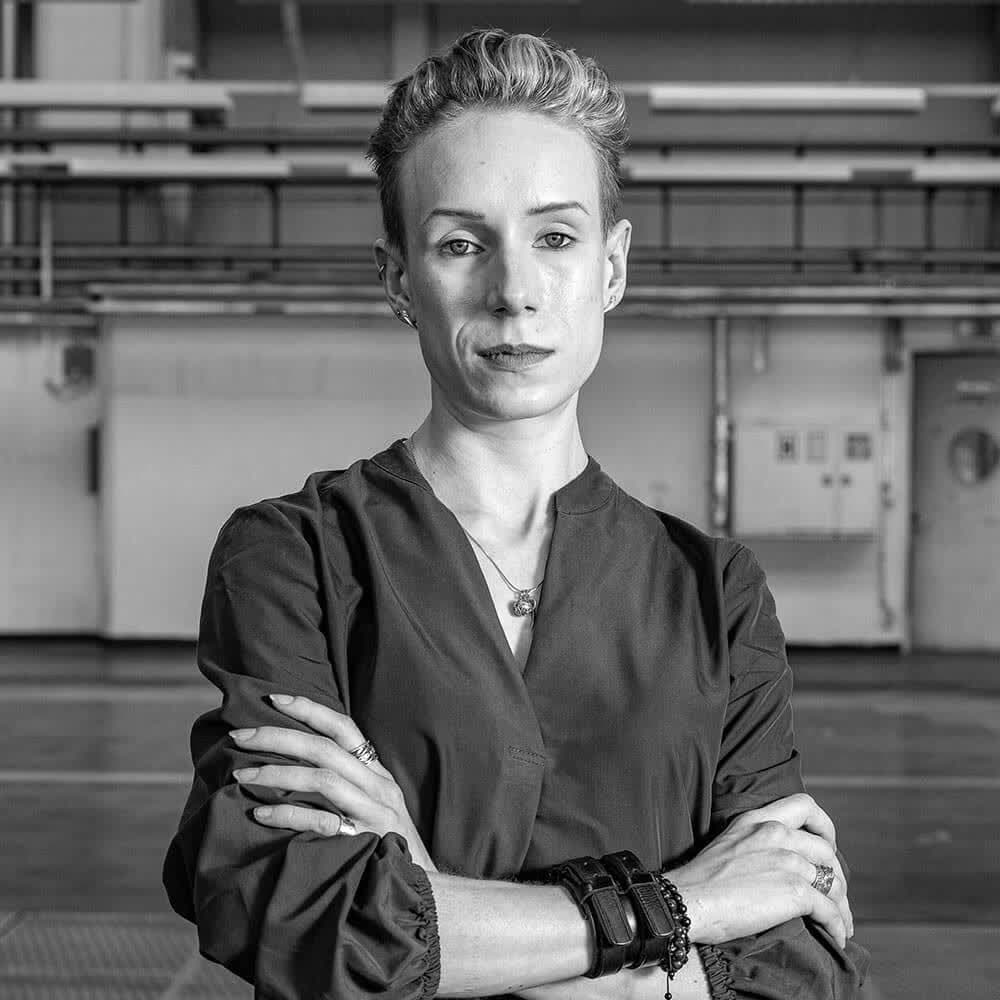
10+ years EEG/HRV research. Core IP co-inventor.
CTO & Co-founder
Marco
Accardi

Built the research pipeline. Core algorithm architecture.
CEO & Co-founder
Alessandro
De Angelis

Oracle, Plug & Play partnerships. Enterprise go-to-market.
CMO
Sabrina
Pippa

Brand and visual communication.
Research Network
MIT Media Lab · D-Wave Systems
Partners
Oracle · NVIDIA Inception · Plug & Play
For Researchers
Run A.R.I.A.'s calibration analysis on your own wearable dataset — at no cost. Get per-subject accuracy with and without personalization, calibration gain analysis, and architecture comparison.
Learn MoreFor Device Makers
Building a wearable with stress detection? We have the only published calibration benchmark on Samsung Galaxy Watch data. Our paper measures exactly what it costs to personalize — and how to do it.
Get in Touch